
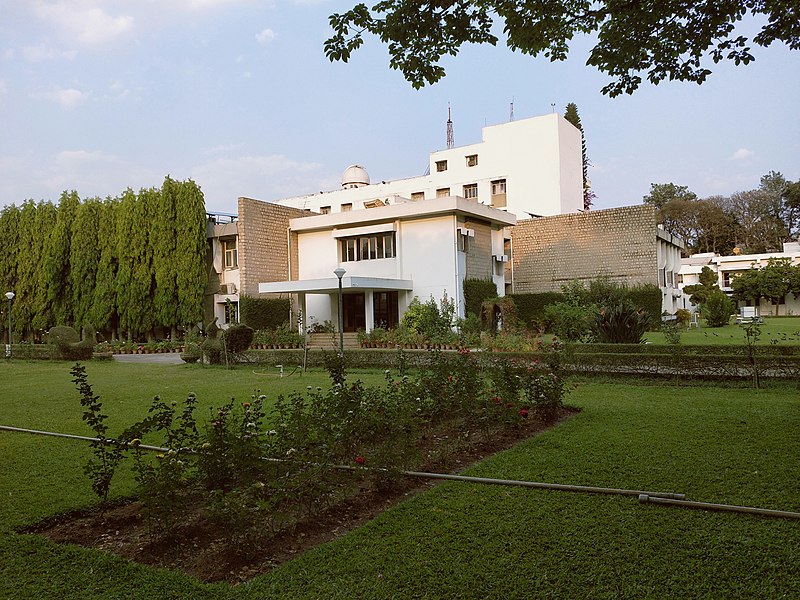
The Indian Institute of Astrophysics (IIA), with its headquarters in Bengaluru, is an autonomous research institute wholly funded by the Department of Science and Technology, Government of India. IIA conducts research primarily in the areas of astronomy, astrophysics and related fields.
The institute has a network of laboratories and observatories in India, including Kodaikanal (the Kodaikanal Solar Observatory), Kavalur (the Vainu Bappu Observatory), Gauribidanur (the Gauribidanur Radio Observatory), Hanle (the Indian Astronomical Observatory) and Hosakote.
IIA contributed to Astrosat, India’s first dedicated multi-wavelength space observatory. The Astrosat project is a collaborative effort of many different research institutions from India. The institute led the development of Ultra-Violet Imaging Telescope (UVIT).
William Petrie (died: 1816), an officer of the East India Company set up private observatory in his residence located in Egmore, Chennai (formerly Madras), India. The main aim of the observatory, according to Petrie, was
“to provide navigational assistance to the company ships and help determine the longitudes by observing the eclipses of Moon and satellites of Jupiter”.
In 1790, this private observatory was taken over by the East India Company, with Michael Topping (1747–96) as an astronomer. In 1792, the observatory was expanded and shifted to a complex in Nungambakkam area of Chennai. This was the first modern observatory outside Europe.
As early as 1881, Mr. Blanford, then Meteorological Reporter to the government of India, recommended “the improvement of the work of solar observations in order to obtain accurate measures of the sun’s heating power at the earth’s surface and its periodic variations”. In May 1882, the government astronomer at Madras, Norman Robert Pogson, proposed the need for photography and spectrography of the sun and the stars using a twenty-inch telescope, which could be at a hill station in South India.